Getting home should feel easy.
But when strength, balance, flexibility, vision, or mobility begin to change, the short trip from the car to the front door can become surprisingly challenging.
First you have to get out of the vehicle. Then there may be an uneven driveway, a dark walkway, a few steps, a heavy door, or a key that suddenly seems much harder to manage.
Individually, these may seem like small inconveniences. Put them together, and getting safely from the car into the house can become one of the more difficult parts of leaving home.
Fortunately, there are some relatively simple ways to make this everyday transition safer and easier.
As an Amazon Associate, Age With Intent earns from qualifying purchases at no additional cost to you.
Why Getting From the Car to the House Can Become More Difficult
Getting out of a vehicle requires more movement than we may realize.
You have to turn your body, move your legs out of the vehicle, shift your weight, push yourself into a standing position, establish your balance, and then begin walking.
Changes in strength, flexibility, balance, joint mobility, or vision can make those movements more difficult.
The vehicle itself matters, too. A very low car may require considerable effort to stand up from, while a tall truck or SUV may require a large step down.
Once you’re standing, there may be an entirely different set of challenges between you and the front door.
That’s why it’s helpful to look at the entire route, rather than focusing on only one problem.
Step 1: Make Getting Out of the Car Easier
If getting up from the vehicle seat has become difficult, your first instinct may be to grab the open car door and pull yourself up.
The problem is that a car door can move.
A more stable handhold may make the transition easier.
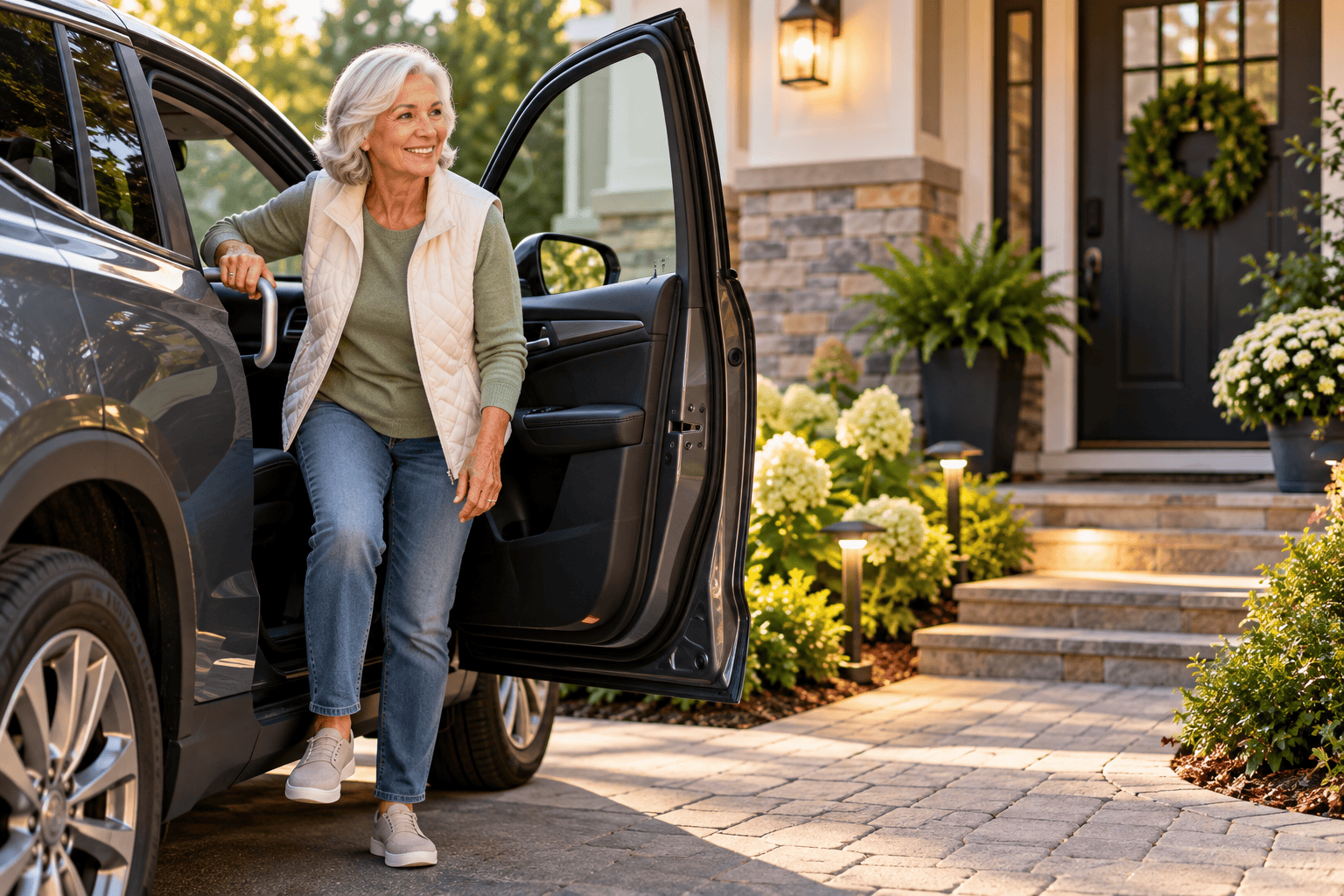
Consider a Car Door Assist Handle
One simple option is a portable car door assist handle.
These devices fit into the vehicle’s door striker—the sturdy metal latch attached to the vehicle frame—and create a handle you can push down on while standing up.
For someone who has adequate arm strength but needs a little extra support when rising from the seat, this can be surprisingly helpful.
They’re also small enough to keep in the vehicle.
Shop car door assist handles on Amazon →
Before purchasing one, make sure the device is compatible with your vehicle and follow the manufacturer’s directions carefully.
And once you’re driving, store the handle securely rather than leaving it loose inside the vehicle.
Try the Sit-and-Swivel Method
How you get out of the vehicle can make a difference, too.
Instead of trying to stand while you’re still partly facing forward:
Turn your body toward the open door.
Bring both legs outside the vehicle.
Place both feet firmly on the ground.
Move toward the edge of the seat.
Use a secure support if needed.
Stand slowly and establish your balance before walking away.
Reverse the process when getting into the car: sit first and then bring your legs into the vehicle.
Some people also find a swivel seat cushion helpful for turning.
However, any aftermarket device used inside a vehicle needs to be considered carefully because it shouldn’t interfere with the vehicle’s seats, seat belts, airbags, or other safety systems.
Step 2: Give Yourself a Moment Before Walking
There’s no prize for getting out of the car quickly.
Once you’re standing, take a moment.
Make sure you feel steady before you begin walking.
This is particularly important if you sometimes experience dizziness or lightheadedness when changing positions.
If getting out of the vehicle consistently leaves you feeling unsteady, weak, dizzy, or in pain, that’s worth discussing with your healthcare provider rather than simply trying to compensate with another product.
Step 3: Make the Path From the Car Easy to Navigate
Now look at the route between the vehicle and the house.
Ask yourself:
Could I safely walk this path at night, in the rain, or while carrying something?
Check for:
Uneven pavement
Cracks
Loose gravel
Raised edges
Garden hoses
Leaves and debris
Poor drainage
Snow and ice
Changes in elevation
Clutter near the entrance
Ideally, the route should be as level, clear, and direct as possible.
If you use a cane or walker, make sure there’s enough space to maneuver comfortably.
This is an important part of home safety for older adults, because preventing a fall begins before you ever reach the front door.
Step 4: Improve Outdoor Lighting
A walkway that’s perfectly manageable during the day may feel very different after dark.
Good lighting can make it easier to identify steps, uneven surfaces, ice, and other potential hazards.
Consider lighting:
The parking area
The path from the vehicle
Steps
Porch areas
The front door
Garage entrances
Traditional wired lighting is often the most dependable option for areas where reliable illumination is essential.
But outdoor solar motion sensor lights can also be useful for supplementing existing lighting or illuminating areas where adding electrical wiring would be difficult.
Motion-activated lights have the added advantage of turning on automatically as you approach.
Read: Outdoor Solar Motion Sensor Lights for Safer Walkways →
Step 5: Make Steps Safer
Even one or two steps can become difficult when balance, leg strength, or joint mobility changes.
Every outdoor stairway should be evaluated carefully.
Look for:
Loose or uneven steps
Slippery surfaces
Poor lighting
Missing or unstable handrails
Step edges that are difficult to see
A sturdy handrail can make an enormous difference.
Whenever possible, handrails should allow you to maintain support throughout the entire transition rather than requiring you to reach awkwardly for something nearby.
Don’t rely on door handles, decorative railings, unstable furniture, or other objects that weren’t designed to support your body weight.
Would a Ramp Make More Sense?
Sometimes improving the stairs isn’t enough.
A properly designed ramp may make an entrance easier to navigate for someone using a walker, wheelchair, or other mobility aid—or for anyone who has increasing difficulty with steps.
But a ramp isn’t simply a board placed over the stairs.
Length, slope, landing space, handrails, surface traction, drainage, and local building requirements all matter.
If a ramp is going to become a primary entrance, consider having it professionally evaluated or installed.
Step 6: Make the Door Easier to Open
You’ve made it out of the vehicle and safely across the walkway.
Now you still have to get through the door.
Traditional round doorknobs can become difficult to operate if grip strength or hand dexterity changes.
A lever-style door handle is often easier because it doesn’t require the same gripping and twisting motion.
You may be able to operate it with your hand, fingers, or even your forearm when your hands are full.
The keypad lock we use: View the Schlage keypad lock on Amazon →
Consider Keyless Entry
A keypad or smart lock can eliminate another small frustration: finding and manipulating a key.
Instead of holding a small key, inserting it into the lock, and twisting it, you may be able to enter a code or use another form of keyless access.
Some smart locks can also provide temporary access for trusted family members, caregivers, or service providers.
That can be particularly useful when planning to age in place.
If you’re considering one, look for a system that’s simple to operate and has a backup way to enter if the battery or technology fails.
Step 7: Think About the Garage Entrance Too
The front door isn’t always the entrance we use most often.
If you normally park in a garage, evaluate that route just as carefully.
Many homes have one or two steps between the garage and house.
Check whether:
The steps are sturdy
The area is well lit
There’s a secure handrail
There’s enough room to maneuver
The floor becomes slippery when wet
The door is easy to unlock and open
Sometimes adding a properly installed handrail or grab bar at a garage entrance can make the transition considerably easier.
The important word is properly installed. Anything intended to support body weight needs to be securely mounted into an appropriate structural surface.
A Simple Car-to-Door Safety Check
The next time you arrive home, don’t go inside on autopilot.
Pay attention to every movement.
Ask yourself:
Is getting out of the vehicle becoming difficult?
Do I have something secure to hold onto?
Do I feel steady when I first stand?
Is the walking surface level and clear?
Can I see the entire route after dark?
Are steps easy to identify?
Is there a secure handrail?
Can I comfortably unlock and open the door?
Would I still feel safe doing this in rain or winter weather?
Could I manage the route while carrying groceries?
You may discover that the problem isn’t one major obstacle.
It’s several little ones.
And that’s good news, because many little obstacles can be corrected fairly easily.
Don’t Forget Strength and Balance
Products and home modifications can make the environment safer, but maintaining your own strength and balance is important too.
Strong legs make it easier to rise from a car seat, climb steps, and recover from small changes in balance.
Regular walking, balance activities, and strength training for older adults can all support everyday mobility.
If getting in and out of the car or climbing your front steps has become noticeably more difficult, a physical or occupational therapist may also be able to identify what’s causing the difficulty and recommend safer techniques or appropriate equipment.
When a Product Isn’t Enough
A car assist handle, better lighting, or new handrail may solve a relatively minor problem.
But increasing difficulty getting into and out of a vehicle can sometimes signal a larger change in mobility.
Consider talking with a healthcare professional if you or someone you care about is experiencing:
Frequent falls or near-falls
Significant difficulty standing from a seated position
New weakness
Persistent dizziness
Increasing difficulty walking
Significant pain getting in or out of the vehicle
Difficulty safely using stairs
An occupational therapist can also evaluate everyday activities such as vehicle transfers and home entry and help identify modifications that fit the individual’s abilities.
Independence Is About More Than Driving
Being able to leave home is an important part of independence.
It’s how we get groceries, attend appointments, meet friends, visit family, go out for dinner, attend community events, and simply enjoy a change of scenery.
If the hardest part of an outing becomes getting from the front door to the car and back again, it’s easy to start going out less often.
That’s why these seemingly small home improvements matter.
The goal isn’t to eliminate every possible risk.
It’s to identify the barriers that are making everyday life harder and find practical ways to reduce them.
A safer transition from the car to the front door can make it easier to keep doing the things that keep life active, connected, and independent.
Keep Making Your Home Work for You
Getting safely into the house is only one part of creating a home that supports you as you get older.
For more practical ideas, read our guide to Home Safety for Older Adults: How to Prevent Falls and Accidents.
And if you’re beginning to think more broadly about aging in place, download the free Age With Intent Aging Well Guide.
It includes practical steps for home safety, healthy living, staying active, and planning ahead—so you can make changes gradually and on your own terms.
Get Your Free Aging Well Guide →
Sources & Further Reading
National Institute on Aging (NIA) — Home Safety Tips for Older Adults
National Institute on Aging (NIA) — Safe Driving for Older Adults
About the Author
I’m Heather, founder of Age With Intent. I have more than 25 years of experience in long-term care leadership, including over 15 years as a Nursing Home Administrator.
Throughout my career, I’ve seen firsthand how important safety, independence, and thoughtful planning are to aging well.
I created Age With Intent to share practical information and resources that help older adults and their families make informed decisions, maintain independence, and live well at every stage of life.