Sometimes the simplest home-safety improvements are the ones we appreciate most.
Outdoor lighting is a good example.
Walking from the driveway to the front door, taking the dog outside, bringing in groceries, or taking out the trash can become much more difficult when you can’t clearly see the walkway, steps, ice, or uneven surfaces.
That’s one reason I’ve used outdoor solar motion sensor lights around my own home for years.
They aren’t complicated. They don’t require an elaborate smart-home system. And because they’re solar powered, many models can be installed without running electrical wiring.
Most importantly, they provide light exactly where you need it.
For anyone thinking about aging in place, better outdoor lighting can be a small improvement that makes a meaningful difference in home safety.
As an Amazon Associate, Age With Intent earns from qualifying purchases at no additional cost to you.
Why Outdoor Lighting Matters as We Get Older
Good lighting becomes increasingly important as we age.
Changes in vision can make it more difficult to see differences in surfaces, judge steps, or notice obstacles—especially in low-light conditions.
Outside the home, that could mean missing:
An uneven section of walkway
The edge of a step
Ice or snow
A garden hose
Leaves or other debris
An object left near the driveway
Changes in elevation
Outdoor lighting won’t eliminate these hazards, but being able to see them clearly gives you a better chance of avoiding them.
It’s one of several relatively simple home-safety improvements that can help make a home easier to navigate as you get older.
Why I Started Using Solar Motion Lights
I originally started using solar motion lights for a very practical reason.
My husband used to leave for work around 6 a.m., when it was still dark. He would turn on the outside light so he could see his way to the car—and, naturally, sometimes that light stayed on after he left.
Motion-activated solar lights solved the problem.
As soon as he walked outside, the lights came on and illuminated his route to the car. After he left, they shut off automatically.
But I quickly realized they were useful for much more than saving electricity.
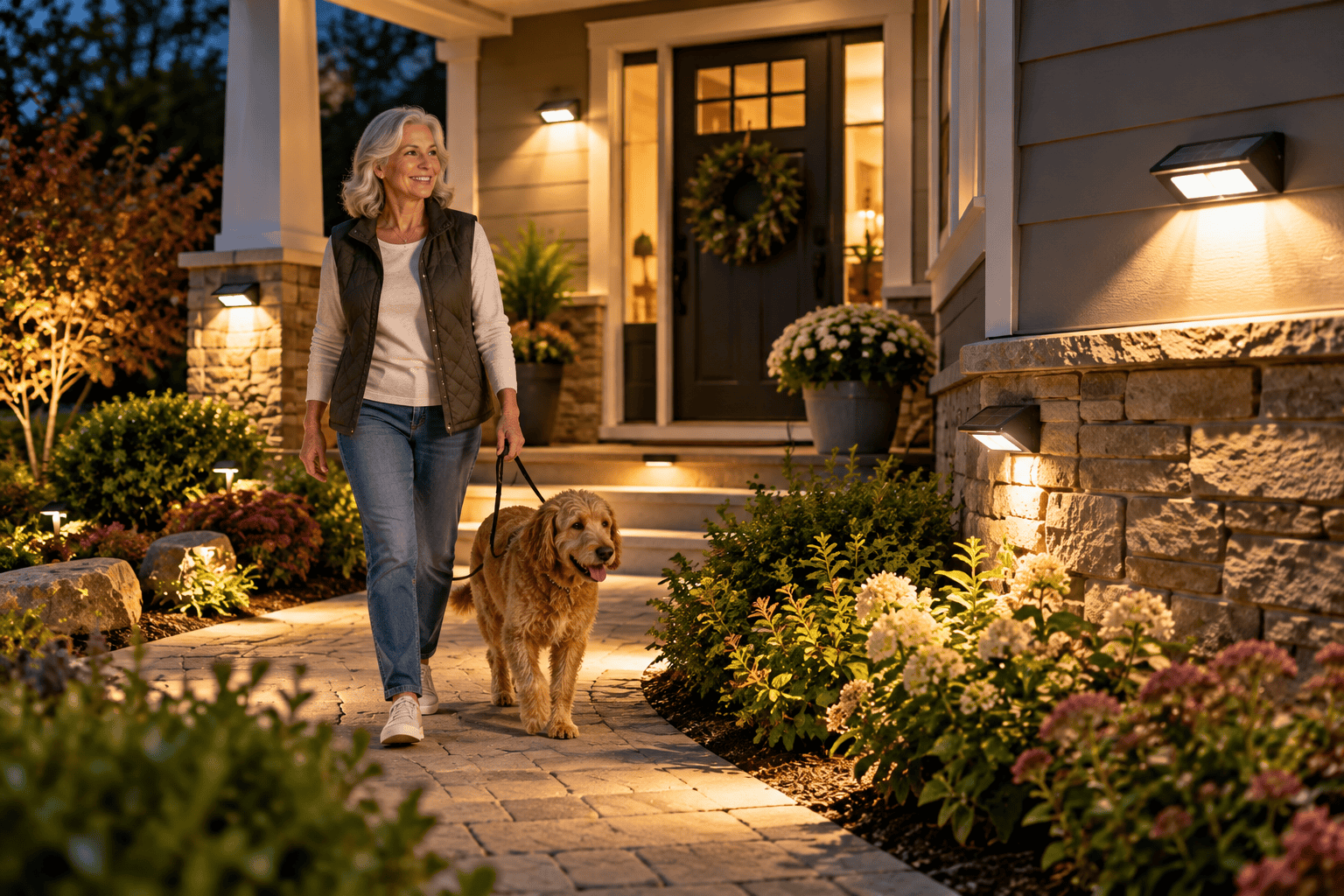
When I arrived home after dark, the lights would come on as I approached the house. I could clearly see the brick walkway, raised areas, the edges of the steps and, during the winter, potentially icy spots.
Living in a cold climate, that last one is particularly important.
I also appreciate the lights when taking the dogs outside in the evening. They illuminate the yard automatically, making it easier to see where I’m walking—and what’s wandering around outside with us.
What started as a convenience became something I now consider part of making the outside of our home safer.
Why Solar Motion Sensor Lights Work Well
There are plenty of options for outdoor lighting, but solar motion lights have several advantages.
No electrical wiring is usually required
Because the lights use energy collected by their solar panels, many can be installed without running new electrical wiring.
That can make them useful in areas where adding traditional lighting would be inconvenient or expensive.
They turn on automatically
You don’t have to remember to flip a switch before going outside.
When the sensor detects movement, the light activates according to the mode you’ve selected.
That’s particularly convenient when you’re carrying groceries, walking a dog, or simply have your hands full.
They don’t need to stay on all night
Depending on the model and settings, the light can remain off or dim until motion is detected.
That means you can have bright illumination when you need it without keeping a bright outdoor light on continuously.
They’re relatively easy to add in multiple locations
Because installation can be simple, you can place lights strategically around different areas of the property rather than relying on one bright porch light to illuminate everything.
Where Should You Put Outdoor Motion Lights?
Think about the routes you actually use after dark.
Good locations may include:
The walkway between your driveway and front door
Front and back steps
Garage entrances
Side doors
Decks and patios
The path to garbage or recycling bins
Areas where you take pets outside
Dark sections alongside the house
Shed or outbuilding entrances
Rather than asking, Where would a light look nice?, ask:
Where might I have difficulty seeing a step, obstacle or change in surface after dark?
That’s where additional lighting may provide the greatest safety benefit.
What to Look for in a Solar Motion Sensor Light
Not all solar lights perform equally well.
If you’re choosing lights primarily for safety rather than decoration, there are several features I’d pay attention to.
Brightness
Decorative solar lights may provide a pleasant glow without producing enough light to clearly illuminate a walking surface.
For safety lighting, look for a model designed to illuminate an area rather than simply create ambiance.
Motion detection
Check the manufacturer’s specifications for detection distance and angle.
Think about where you’ll mount the light and where you want it to activate. Ideally, it should turn on before you reach the dark area rather than after you’re already standing in it.
Adjustable lighting modes
Some lights provide several options, such as:
Off until motion is detected
Dim lighting that becomes brighter with motion
Continuous lower-level lighting
Different modes can work better in different locations.
Solar-panel placement
Solar lights need adequate sunlight to recharge.
A light installed beneath a deep porch roof or in a heavily shaded location may not receive enough sunlight to perform reliably.
Before installing one, pay attention to how much direct sunlight the solar panel receives throughout the day.
Weather resistance
Outdoor lights need to withstand the conditions where you live.
Look at the manufacturer’s weather-resistance rating and recommended operating conditions, particularly if you live somewhere with heavy rain, snow, ice, or very cold winters.
Ease of installation
Installation should be secure but manageable.
Some models attach directly to a wall, fence, deck post, or other surface. Follow the manufacturer’s mounting instructions and make sure the light won’t loosen or fall during bad weather.
The Solar Motion Lights I’ve Used
After trying different solar lights over the years, I’ve repeatedly used URPOWER solar motion sensor lights around my own home.
What I’ve liked most isn’t any single technical specification. It’s that they’ve been simple, practical and useful in the places where I actually need additional light.
I’ve used them around walkways and other dark areas outside the house, and I’ve purchased additional lights as I’ve found more places where they were useful.
One feature I particularly like is having different lighting modes. In some areas, I prefer darkness until movement triggers the light. In others, I like having a low level of illumination that becomes brighter when someone approaches.
Shop URPOWER solar motion sensor lights on Amazon →
Product features and specifications can change over time. Check the current Amazon listing and manufacturer information for the latest brightness, battery, weather-resistance, motion-detection and package details before purchasing.
What I Like About Solar Motion Lights
After using this type of lighting for years, there are several things I particularly appreciate.
They’re automatic. I don’t have to remember to turn an outdoor light on or off.
They’re useful in places without convenient electrical wiring. That makes it easier to add lighting exactly where I want it.
They can improve visibility along walking routes. This is the biggest benefit for me.
They’re unobtrusive. Many solar motion lights are fairly small and don’t dominate the exterior of the house.
It’s easy to add more. You can start with one dark area and add additional lights where you discover they’re needed.
Are There Any Downsides?
Yes—and I think these are important to understand before buying solar lighting.
They depend on sunlight
If the solar panel doesn’t receive enough sunlight during the day, performance may be reduced.
Shady areas can therefore be challenging.
Weather can affect performance
Snow may cover the solar panel, and shorter winter days provide fewer hours of sunlight for charging.
If you live in a northern climate, don’t assume a solar light will perform exactly the same in January as it does in July.
Motion sensors can be triggered unintentionally
Animals, moving branches, flags, or other movement may occasionally activate a sensor.
I’ve experienced this myself with a flag near one of our lights on particularly windy days.
Usually it’s more of an annoyance than a serious problem, but placement matters.
Solar lights shouldn’t be your only safety lighting
This is particularly important.
If a stairway, entrance, ramp, or walkway must be reliably illuminated every time you use it, consider whether permanent wired lighting is the better choice.
Solar motion lights can be an excellent supplement, but critical safety lighting shouldn’t depend entirely on whether a solar battery received enough sunlight that day.
Solar Lights Are Only One Part of Outdoor Fall Prevention
Lighting helps you see hazards. It doesn’t remove them.
Take a look at the outdoor routes you use regularly and check for:
Broken or uneven steps
Loose handrails
Cracked or raised pavement
Slippery surfaces
Leaves and debris
Snow and ice
Items left in walking paths
During winter, keep walkways cleared and treated appropriately for ice.
If stairs are becoming difficult to navigate, adding secure handrails—or considering another accessible entrance—may be more important than simply adding more light.
The goal is to look at the entire walking route, not just one product.
Who Might Benefit From Outdoor Solar Motion Lights?
These lights can be useful for almost anyone, but they’re particularly worth considering if you:
Frequently arrive home after dark
Have poorly lit walkways or steps
Take pets outside at night
Walk between your house and a detached garage
Have areas where installing wired lighting would be difficult
Want additional visibility around entrances
Are making gradual home-safety improvements to support aging in place
They’re also a simple upgrade adult children may want to consider when helping a parent evaluate home safety.
A Small Change That Can Make Home Feel Safer
One of the things I’ve learned about aging in place is that not every improvement needs to be expensive or dramatic.
Sometimes it’s simply noticing something that could become a problem and fixing it before it does.
Outdoor solar motion sensor lights fall into that category for me.
They aren’t a substitute for secure handrails, even walking surfaces, appropriate footwear, or good permanent lighting where it’s needed.
But having light automatically illuminate a dark walkway, step or driveway can make everyday life a little easier—and that’s exactly what good aging-in-place design should do.
The goal isn’t to fill your home with safety products. It’s to make thoughtful changes that help you continue living confidently and independently.
Keep Making Your Home Safer
Outdoor lighting is just one piece of a safer home.
If you’re looking for other practical ways to reduce hazards, improve accessibility, and prepare your home for the years ahead, read our guide to Home Safety for Older Adults: How to Prevent Falls and Accidents.
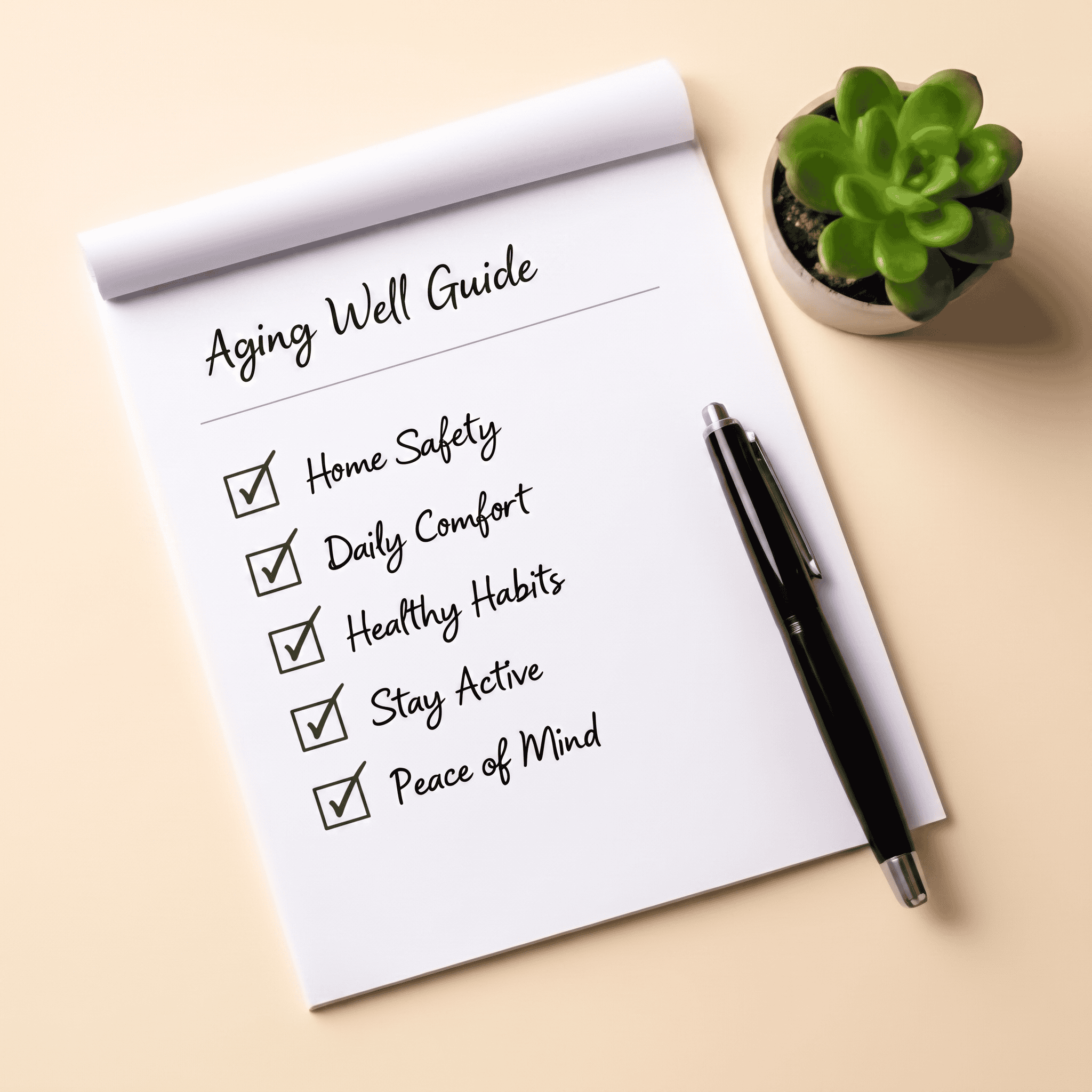
And for a broader approach to planning ahead, download the free Age With Intent Aging Well Guide, with practical ideas for home safety, healthy living, staying active, and maintaining independence.
Get Your Free Aging Well Guide →
Sources & Further Reading
National Institute on Aging (NIA) — Home Safety Tips for Older Adults
About the Author
I’m Heather, founder of Age With Intent. I have more than 25 years of experience in long-term care leadership, including over 15 years as a Nursing Home Administrator.
Throughout my career, I’ve seen firsthand how important safety, independence, and thoughtful planning are to aging well.
I created Age With Intent to share practical information and resources that help older adults and their families make informed decisions, maintain independence, and live well at every stage of life.