
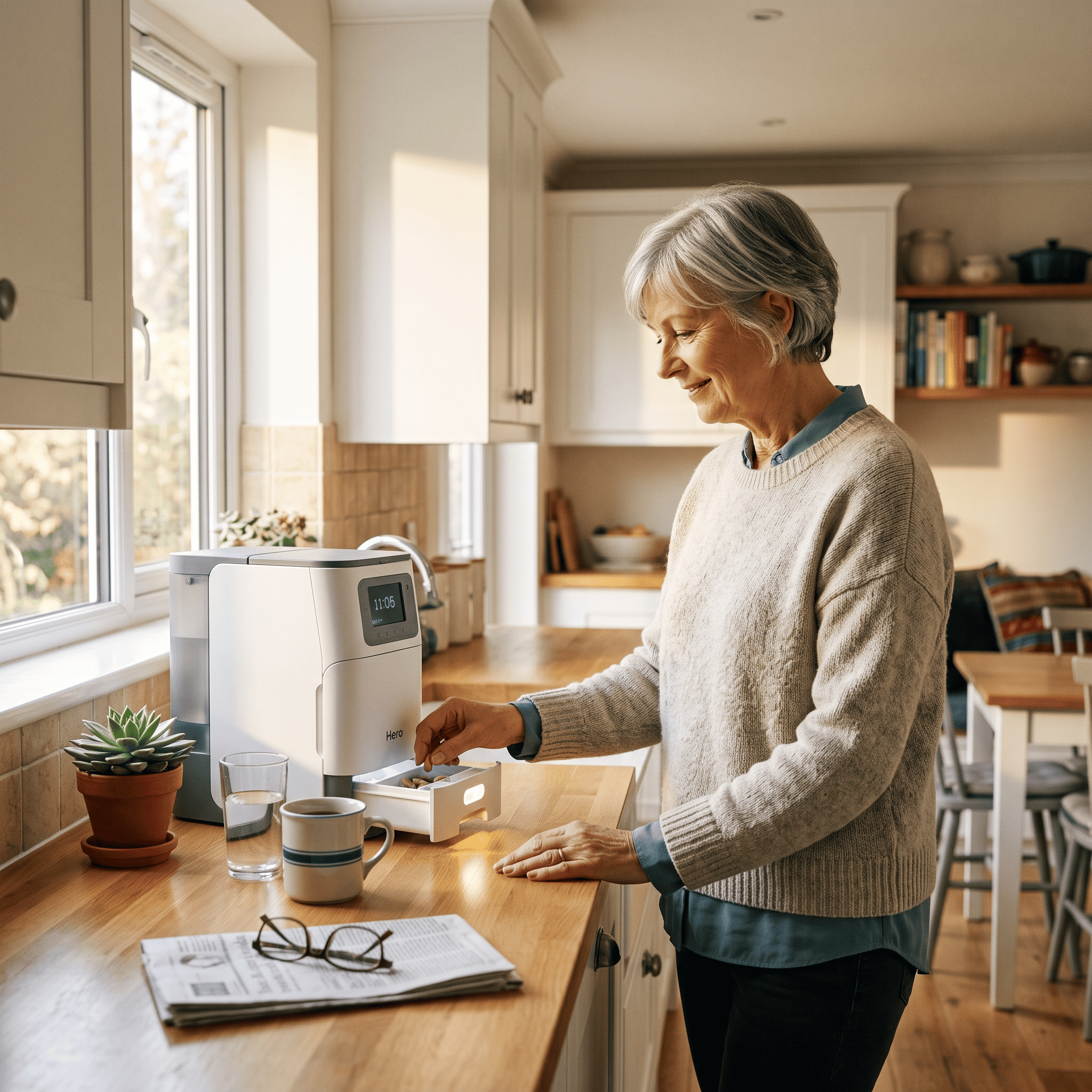
Managing medications can become more complicated over time. A simple weekly pill organizer may work perfectly for someone who needs help separating medications by day. But when medications need to be taken at several different times—or remembering whether a dose has already been taken becomes difficult—a basic pillbox may not provide enough support.
An automatic pill dispenser adds another layer of organization.
These devices can store medications, rotate to the appropriate compartment at scheduled times, and provide audible or visual reminders when it’s time for a dose. Some newer models can even connect to a smartphone and allow a family member or other support person to monitor the medication schedule remotely.
That doesn’t mean everyone needs one.
The right medication-management system depends on the person, the complexity of the medication schedule, and the type of support that’s actually needed.
Here’s how automatic pill dispensers work, who may benefit from one, what features are worth considering, and how to decide whether one makes sense for you or someone you care about.
Affiliate Disclosure: As an Amazon Associate, Age With Intent earns from qualifying purchases. If you purchase through an affiliate link on this page, we may receive a small commission at no additional cost to you.
Important: Automatic pill dispensers are organizational and reminder tools. They do not determine which medications should be taken or whether medications are safe to take together. Always follow medication instructions provided by your healthcare provider and pharmacist.
What Is an Automatic Pill Dispenser?
An automatic pill dispenser combines medication storage with scheduled reminders.
Most use a circular tray divided into individual compartments. Medications are placed into those compartments ahead of time according to the person’s medication schedule.
At a programmed time, the device rotates to make the appropriate compartment available. An alarm, flashing light, or both lets the person know it’s time to take the medication.
Some models add features such as:
Locking covers
Multiple alarms per day
Large digital displays
Adjustable alarm volume
Smartphone apps
Bluetooth or Wi-Fi connectivity
Remote notifications or monitoring
Battery backup
The important thing to remember is that an automatic dispenser doesn’t decide what belongs in each compartment. Someone still needs to fill and program the device correctly.
Who Might Benefit From an Automatic Pill Dispenser?
An automatic dispenser may be useful for someone who can safely take medications independently once the correct dose is presented but needs additional help with organization or reminders.
It may be worth considering if you or someone you care about:
Takes medications several times throughout the day
Sometimes forgets when a dose is due
Has difficulty remembering whether a dose has already been taken
Finds a traditional pill organizer confusing
Benefits from audible or visual reminders
Wants to maintain greater independence with medication routines
Would benefit from limiting access to medication compartments before they’re scheduled
For some people, the biggest benefit isn’t the automation itself. It’s having a predictable routine that removes some of the mental effort involved in managing several medications.
When Is a Regular Pill Organizer Enough?
More technology isn’t always better.
If medications are taken once or twice a day and remembering them isn’t a problem, a simple weekly pill organizer may be all that’s needed.
Traditional organizers are:
Inexpensive
Easy to fill
Easy to transport
Available with one or several compartments per day
Simple to use without programming or an app
Think first about the problem you’re trying to solve.
If the question is:
“Which pills do I take this morning?”
A traditional pill organizer may be enough.
If the question is:
“Is it time for my medication, and have I already taken this dose?”
An automatic dispenser may provide more useful structure.
Related: How to Organize Medications Safely: Practical Tips for Older Adults
Features to Look for in an Automatic Pill Dispenser
Automatic dispensers vary considerably in complexity and price. You don’t necessarily need the model with the most features.
Look for the features that address the specific medication-management problem you’re trying to solve.
Number of Medication Compartments
Many circular automatic dispensers have 28 compartments.
How long those compartments last depends on the number of medication times each day.
For example, a 28-compartment dispenser could provide approximately:
28 days at one dose time per day
14 days at two dose times per day
9 days at three dose times per day
7 days at four dose times per day
Someone taking medications several times daily will therefore need to refill the dispenser more frequently.
Number of Daily Alarms
Check how many medication times the dispenser can accommodate each day.
Some basic models support several daily doses, while newer models may allow as many as nine scheduled medication times.
More isn’t necessarily better. Choose a dispenser that accommodates the actual medication schedule without adding unnecessary complexity.
Audible and Visual Reminders
Look for an alarm that’s easy for the person using the dispenser to notice.
Some models combine sound with flashing lights, while others offer adjustable tones and volume levels.
If hearing or vision is limited, this deserves particular attention.
Display Size and Controls
Large numbers, clearly labeled buttons, and a readable display can make a significant difference.
A dispenser with impressive technology isn’t particularly helpful if the person using it can’t comfortably read or operate it.
Locking Cover
Many automatic dispensers have a locking lid that limits access to medication compartments that aren’t currently scheduled.
This can add a useful layer of protection against accidental access.
However, a consumer medication dispenser should not be considered completely tamper-proof or a substitute for appropriate medication supervision.
Battery or Plug-In Power
Some models run on replaceable batteries. Others use electrical power with battery backup.
Battery-powered models can be convenient for travel and placement around the home, while plug-in models may offer more advanced connected features.
Consider what happens during a power outage and whether the dispenser retains its programming.
Smartphone Connectivity
Some newer automatic dispensers connect to a smartphone using Bluetooth or Wi-Fi.
This can make programming easier and may allow medication schedules and device settings to be managed through an app.
Remote Monitoring
More advanced Wi-Fi models may allow a family member or other authorized person to remotely monitor the medication schedule and receive notifications.
This can be useful when an older adult lives independently but a family member wants an additional way to stay informed.
It’s not necessary for everyone, and it usually increases the cost of the dispenser.
A Closer Look at LiveFine Automatic Pill Dispensers
LiveFine is one of the more established brands offering this style of automatic dispenser.
Rather than selling just one model, LiveFine now offers several levels of medication support, ranging from basic automatic dispensers to app-connected Bluetooth and Wi-Fi versions.
Most use the same basic concept: a circular tray with 28 medication compartments, scheduled dispensing, and audible and visual reminders.
LiveFine Standard Automatic Pill Dispensers
The standard LiveFine models are best suited to someone who wants timed dispensing and reminders without needing remote monitoring.
Depending on the model, features may include:
28 medication compartments
Multiple scheduled medication times per day
Audible and visual alerts
Large LCD display
Locking cover
Battery operation
Clear or frosted lid
For someone whose primary needs are organization and reminders, this may be enough.
LiveFine Bluetooth Models
LiveFine also offers Bluetooth-connected dispensers that work with the LiveFine smartphone app.
The app can make it easier to set medication schedules and adjust dispenser settings using a larger phone or tablet screen.
This may appeal to someone who is comfortable using a smartphone but doesn’t necessarily need remote monitoring from another location.
LiveFine Wi-Fi Models
The Wi-Fi versions add another level of connectivity.
Depending on the model, these dispensers can allow authorized family members or others to monitor the medication schedule through the LiveFine app and receive information remotely.
That may be useful for someone living independently who benefits from an additional layer of support.
The trade-off is cost and complexity. If remote monitoring isn’t needed, paying more for a Wi-Fi model may not provide much additional value.
What I Like About the LiveFine Design
There are several things I like about the overall LiveFine approach.
It Can Support Independence
For someone who can safely self-administer medications but benefits from reminders, an automatic dispenser can reduce the need for another person to provide every medication prompt.
That can be meaningful for someone who values managing as much of their daily routine independently as possible.
The System Is Relatively Straightforward
The circular 28-compartment design is easy to understand once it’s properly filled and programmed.
At the scheduled time, the device presents the appropriate compartment rather than requiring the user to decide which section of a pillbox to open.
There Are Different Levels of Technology
I particularly like that someone doesn’t have to purchase a connected Wi-Fi model simply to get automatic dispensing.
A person can choose a basic dispenser, a Bluetooth model, or a more connected Wi-Fi option depending on the level of support needed.
Audible and Visual Reminders Provide More Than One Cue
Having both sound and light may be useful for someone who doesn’t consistently notice one type of reminder.
Limitations to Understand Before Buying
Automatic pill dispensers can be helpful, but it’s important to understand what they cannot do.
They Still Have to Be Filled Correctly
The dispenser can rotate to the correct compartment only if the correct medications were placed there in the first place.
For a complicated medication schedule, filling the device may require help from a family member, pharmacist, nurse, or other appropriate person.
They Don’t Confirm That Medication Was Swallowed
A dispenser can make a scheduled dose available.
It cannot guarantee that the person actually took the medication.
That’s particularly important when considering a dispenser for someone who needs significant medication supervision.
Not Every Medication Belongs in a Dispenser
Some medications have special packaging or storage requirements.
Before removing medications from their original packaging and placing them into a dispenser, ask your pharmacist if you’re unsure whether that’s appropriate.
Setup Can Take Some Practice
Programming several medication times can be more complicated than filling a weekly pillbox.
I would set up and test any automatic dispenser before depending on it for an actual medication schedule.
Technology Can Add Complexity
Bluetooth, Wi-Fi, smartphone apps, and remote monitoring can be helpful—but only when they solve a real problem.
For someone who dislikes smartphones or simply needs a loud reminder at medication time, a basic dispenser may actually be the better choice.
Basic, Bluetooth, or Wi-Fi: Which Is Right for You?
A simple way to think about the choices is by the level of support needed.
Choose a Basic Automatic Dispenser If:
You primarily need timed dispensing, audible or visual reminders, and controlled access to scheduled compartments.
Consider a Bluetooth Dispenser If:
You want automatic dispensing but would find it easier to program and manage settings through a smartphone or tablet.
Consider a Wi-Fi Dispenser If:
Remote monitoring or notifications for a family member or other support person would be genuinely useful.
Don’t pay for connectivity simply because it’s available.
The best dispenser is the simplest device that reliably meets the person’s actual needs.
Automatic Pill Dispenser Safety Considerations
Medication-management tools should support a safe medication routine—not replace communication with healthcare professionals.
The FDA notes that older adults are more likely to use multiple prescription and over-the-counter medicines, which can increase the risk of side effects and drug interactions.
Keep an updated list of:
Prescription medications
Over-the-counter medicines
Vitamins
Dietary and herbal supplements
Medication doses
When each medication is taken
Share that list with healthcare providers and your pharmacist.
Never use an automatic dispenser to change a medication schedule or combine medications differently from the instructions you’ve been given.
If medications change frequently, review and refill the dispenser carefully each time the medication list changes.
Who May Need More Support Than an Automatic Dispenser Provides?
An automatic pill dispenser isn’t appropriate for every situation.
Someone may need a different or more supportive medication-management system if they:
Cannot safely self-administer medications
Need confirmation that medications were actually taken
Frequently attempt to access medications before scheduled times
Have medications that change often
Cannot hear or see the dispenser alerts
Cannot physically operate the device
Have significant difficulty understanding the medication routine
Take medications with special storage or packaging requirements
If you’re unsure about the appropriate level of medication support, discuss the situation with a pharmacist or healthcare professional.
Are Automatic Pill Dispensers Worth It?
For the right person, yes.
I think automatic pill dispensers are most valuable when they solve a specific medication-management problem.
If someone simply needs a place to organize pills, a traditional weekly organizer is probably the easier and less expensive choice.
But when the challenge involves remembering medication times, distinguishing one dose from another, or limiting access to unscheduled compartments, an automatic dispenser can provide useful additional structure.
Connected models can add another level of support when remote monitoring is genuinely needed.
The key is matching the device to the person—not choosing the device with the longest list of features.
What I Would Look for First
If I were choosing an automatic pill dispenser, I would prioritize:
Ease of use
An alarm the person can reliably hear or see
Enough daily dose settings for the medication schedule
A display and controls that are easy to understand
Appropriate capacity
A locking cover if access to unscheduled compartments is a concern
Reliable power or battery backup
Remote monitoring only if it’s actually needed
Those features matter more to me than having the newest technology.
Medication Management Is About the Right Level of Support
The goal of medication organization isn’t to add more technology to someone’s life.
It’s to make a necessary daily routine safer, simpler, and easier to manage.
For one person, that may mean a seven-day pillbox.
For another, phone reminders may be enough.
And for someone managing several medication times each day, an automatic dispenser may provide exactly the additional structure needed to remain more independent.
Start with the problem you’re trying to solve, then choose the simplest system that addresses it. That’s a much better approach than starting with the product.
Related Reading
How to Organize Medications Safely: Practical Tips for Older Adults
Managing Chronic Health Conditions After 60: Practical Tips for Living Well
Your Next Step Toward Aging Well
Aging well is about more than staying healthy. It’s about feeling confident, staying independent, and making thoughtful choices for the future.
Our FREE Aging Well Guide offers practical tips for home safety, healthy and active living, and planning ahead—so you can take meaningful steps toward living well at every age.
Get Your Free Aging Well Guide →
Practical guidance to help you live well and age with purpose.
Sources & Further Reading
U.S. Food & Drug Administration (FDA): 5 Medication Safety Tips for Older Adults
National Institute on Aging (NIA): Medicines and Medication Management
About the Author
I’m Heather, founder of Age With Intent. I have more than 25 years of experience in long-term care leadership, including over 15 years as a Nursing Home Administrator.
Throughout my career, I’ve seen firsthand how important safety, independence, and thoughtful planning are to aging well.
I created Age With Intent to share practical information and resources that help older adults and their families make informed decisions, maintain independence, and live well at every stage of life.