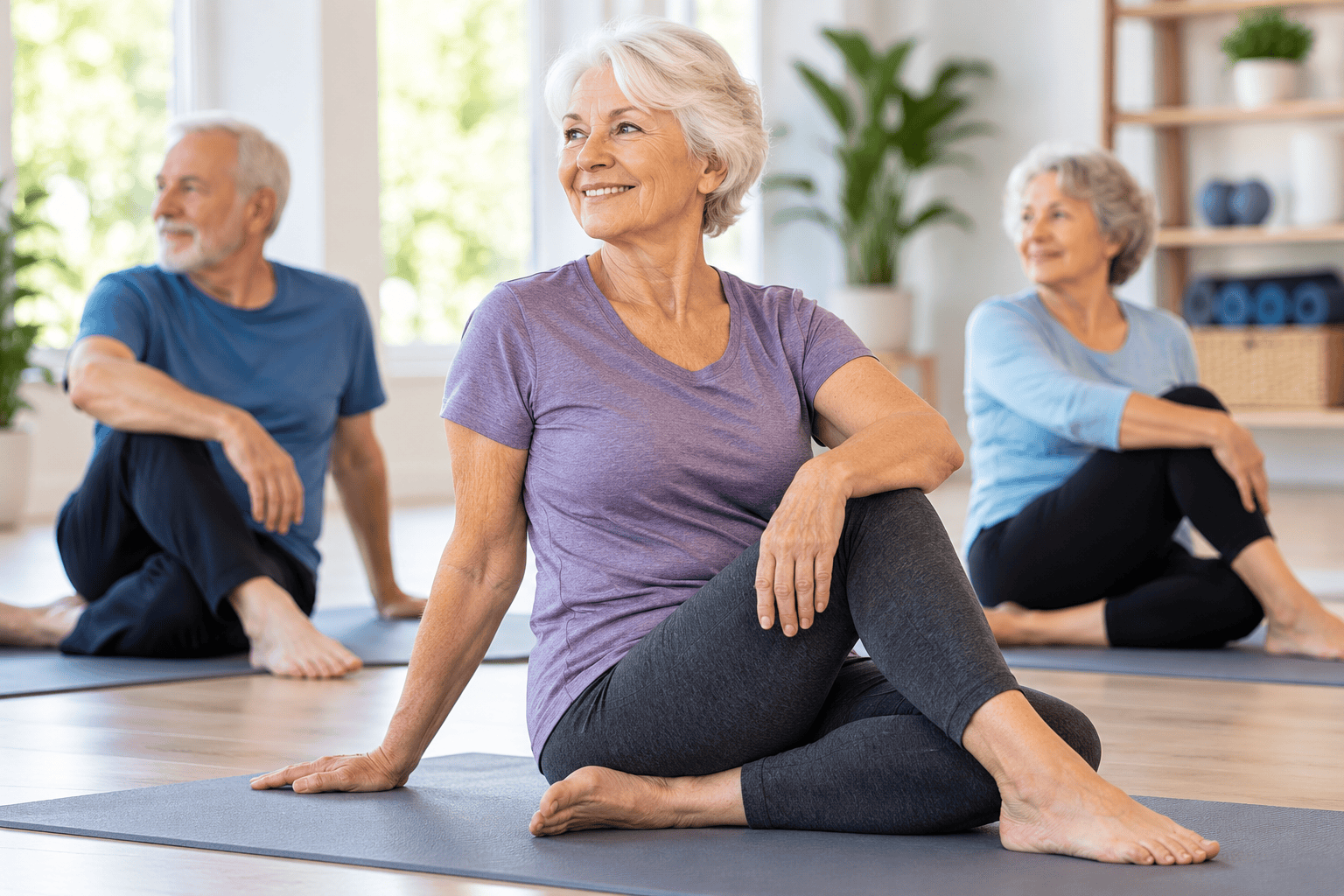
Staying active is one of the most important things we can do to support our independence as we get older. But staying active doesn’t necessarily mean running, lifting heavy weights, or doing strenuous workouts.
For many older adults, yoga offers a gentler way to keep the body moving while also supporting balance, flexibility, strength, and relaxation.
And you don’t have to be flexible to begin.
Yoga can be adapted to different fitness levels and physical abilities. Some people practice standing on a mat, while others use a chair, wall, blocks, or other supports. The goal isn’t to master difficult poses. It’s to keep moving in a way that feels comfortable and sustainable.
Why Yoga Can Be Especially Helpful as We Age
Our bodies naturally change with age. We may notice that we’re a little stiffer getting out of bed, that reaching or bending isn’t quite as easy as it once was, or that our balance isn’t as dependable.
Regular movement can help us maintain the physical abilities we use every day.
Yoga combines several elements—movement, stretching, balance, breathing, and, depending on the style, some muscle-strengthening activity. That combination makes it particularly interesting for healthy aging.
Here are some of the potential benefits.
1. Yoga Can Help Maintain Flexibility
Flexibility isn’t about being able to touch your toes. It’s about maintaining enough range of motion to comfortably perform everyday activities.
Think about reaching into a cabinet, putting on your shoes, getting dressed, gardening, or turning to look behind you.
Yoga gently moves the body through different positions and stretches. Over time, regular practice may help maintain or improve flexibility, particularly in areas that tend to become tight.
The National Institute on Aging notes that stretching can help maintain and improve flexibility, which can make both exercise and everyday activities easier.
2. Yoga Can Support Better Balance
Balance becomes increasingly important as we get older because falls can have serious consequences.
Many yoga poses require you to stabilize your body, shift your weight, or maintain a position. These movements can challenge the systems involved in balance without requiring fast or high-impact exercise.
Research reviewed by the National Center for Complementary and Integrative Health (NCCIH) suggests that yoga may improve balance in older adults.
For someone who isn’t comfortable standing unsupported, balance exercises can often be modified by using a chair or wall.
3. Yoga Can Help Build and Maintain Strength
Yoga probably shouldn’t replace a complete strength-training program, but many yoga poses require your muscles to support and stabilize your body.
Holding a standing pose, rising from a chair, or maintaining proper posture all require muscle engagement.
The CDC includes some yoga postures among activities that can contribute to muscle strengthening and identifies yoga as a type of multicomponent physical activity.
Maintaining strength matters for much more than exercise. It helps with everyday tasks such as climbing stairs, carrying groceries, getting out of a chair, and remaining independent.
4. Yoga May Help With Stress and Relaxation
Yoga isn’t only physical exercise.
Many forms of yoga incorporate controlled breathing, mindfulness, and periods of relaxation. That combination can provide an opportunity to slow down and focus on the present moment.
Research suggests yoga may help with stress management and support mental and emotional well-being.
Even a short, gentle practice can provide a quiet break from a busy day.
5. Yoga May Support Better Sleep
Sleep can sometimes become more challenging with age.
Research on yoga and sleep is still evolving, but studies involving older adults suggest that yoga may have a positive effect on sleep quality.
A relaxing yoga routine doesn’t have to be complicated. Gentle stretching and slow breathing in the evening may be an enjoyable way to wind down before bed.
Yoga shouldn’t be viewed as a treatment for persistent sleep problems, however. If you’re experiencing ongoing insomnia or significant changes in your sleep, it’s worth discussing them with your healthcare provider.
6. Yoga Can Be a Social Activity
One benefit that’s easy to overlook is simply getting out and doing something with other people.
A yoga class at a senior center, recreation department, fitness center, or community organization can provide both physical activity and regular social interaction.
Finding activities you genuinely enjoy—and people you enjoy doing them with—can make it much easier to stay active consistently.
Staying physically active and socially connected are both important parts of healthy aging.
What Type of Yoga Is Best for Older Adults?
There’s no single type of yoga that’s best for everyone. The right choice depends on your mobility, experience, health, and comfort level.
Gentle or beginner yoga is a good place to start if you’re new to yoga. These classes typically move more slowly and give you time to learn each position.
Hatha yoga is another option to explore. Classes often focus on basic poses and breathing at a slower pace, although difficulty can vary considerably between instructors.
Chair yoga can be particularly helpful for people who have difficulty getting down to the floor or standing for long periods. Many stretches and movements can be performed while seated or while using the chair for support.
Iyengar yoga places considerable emphasis on body alignment and frequently uses props such as blocks, straps, blankets, and chairs to modify poses.
Whatever style you choose, look for a class described as beginner, gentle, senior-friendly, or appropriate for older adults.
The instructor matters just as much as the style. Ideally, choose someone who is experienced in modifying movements for older adults and different physical abilities.
Is Yoga Safe for Seniors?
Yoga is generally considered safe for healthy people when practiced appropriately, but injuries can happen.
According to NCCIH, older adults should take particular care when beginning yoga. Certain medical conditions, balance difficulties, joint problems, spinal conditions, glaucoma, or other health concerns may require poses to be modified or avoided.
If you have a health condition, previous injury, significant balance problem, or haven’t exercised recently, talk with your healthcare provider before beginning a new exercise program.
When you’re getting started:
Choose a beginner or senior-friendly class.
Tell the instructor about physical limitations or injuries.
Use a chair, wall, blocks, or other supports when needed.
Move slowly and avoid forcing a stretch.
Stop if a movement causes pain.
Avoid advanced positions such as headstands and shoulder stands unless an appropriately qualified professional has determined they are suitable for you.
Yoga isn’t about pushing your body as far as it can go. A good practice works with your body as it is today.
Making Yoga Part of a Healthy Aging Routine
Yoga doesn’t have to be complicated—or require impressive flexibility—to be worthwhile. One of its greatest advantages is how easily it can be adapted to your current abilities.
You might start with a gentle beginner class, try chair yoga, or simply spend 10 or 15 minutes at home practicing a few basic stretches and breathing exercises. Over time, those small sessions can become an enjoyable part of your routine.
Yoga can be especially helpful for supporting:
Balance and stability, which become increasingly important as we age
Flexibility and mobility for everyday activities
Strength, particularly when poses require you to support your own body weight
Relaxation and stress management
Body awareness and confidence with movement
Social connection when practiced in a class or group setting
Yoga works best as one part of a well-rounded approach to staying active. Walking, strength training, and other activities you enjoy can complement yoga and help you maintain the strength, endurance, balance, and mobility you need for everyday life.
A Few Safety Tips Before You Begin
If you’re new to yoga, start slowly and choose a class or routine designed for beginners or older adults. A qualified instructor can show you how to modify poses and use a chair, wall, blocks, or other supports when needed.
Never force yourself into a position or continue a movement that causes sharp pain. Yoga should challenge you gently—not hurt.
If you have significant balance problems, osteoporosis, joint problems, a recent injury or surgery, or another medical condition that affects your ability to exercise safely, talk with your healthcare provider before beginning a new exercise program.
The Bottom Line
You don’t need to be young, flexible, or athletic to benefit from yoga.
For adults in their 60s, 70s, 80s and beyond, yoga can be a gentle and adaptable way to keep moving, improve balance and flexibility, build strength, and create a little more calm in the day.
And perhaps most importantly, yoga can support something that matters enormously as we get older: the ability to keep doing the things we enjoy and living life on our own terms.
Start where you are. Use the support you need. And remember that even a few minutes of intentional movement is a step in the right direction.
Keep Building a Healthier, More Active Life
Yoga is just one way to stay strong and independent as you age. Walking, strength training, good nutrition, a safe home environment, and staying socially connected all play a role.
If you’d like more practical ideas for living well and maintaining your independence, download our free Age With Intent Aging Well Guide. It includes simple steps you can take to make your home safer, support your health, and plan confidently for the years ahead.
Get Your Free Aging Well Guide →
Sources & Further Reading
For more information about yoga, physical activity, and healthy aging:
National Center for Complementary and Integrative Health (NCCIH) — Yoga: What You Need to Know
Centers for Disease Control and Prevention (CDC) — Physical Activity for Older Adults
National Institute on Aging (NIA) — Exercise and Physical Activity
American College of Sports Medicine (ACSM) — Physical Activity Guidelines and Resources
About the Author
I’m Heather, founder of Age With Intent. I have more than 25 years of experience in long-term care leadership, including over 15 years as a Nursing Home Administrator.
Throughout my career, I’ve seen firsthand how important safety, independence, and thoughtful planning are to aging well.
I created Age With Intent to share practical information and resources that help older adults and their families make informed decisions, maintain independence, and live well at every stage of life.